Author: komarnis@ualberta.ca

  • Q. How to build a sustainability dream team?

    1. Sustainability professionals and subject matter experts

    Sustainability professionals and subject matter experts are essential to conceptualize, develop and drive sustainability initiatives. These are engineers, scientists, developers, supply chain experts, business personnel and others who have the technical skills and experience to revolutionize products, services, and operations.


    1. Accountants and Lawyers

    Both lawyers and accounts excel in highlighting in managing risk and can therefore act as guardrails to keep your sustainability goals on track and realistic.


    Accountants can assess the financial impact of sustainability, and measure ESG. Recent ESG disclosure legislation includes assurance requirements, therefore accounts will be indispensable for reviewing, measuring and validating ESG going forward.


    Lawyers are trained in systems thinking, they can adopt a big picture to show how issues may start a chain reaction and may play out down the road. Lawyers also view compliance more wholistically, and therefore can advise on being efficient in risk screening, for example, a company can screen for corruption and bribery in their supply chain at the same time they screen for forced labor violations. Lastly lawyers reduce the risk of greenwashing litigation and non-compliance by ensuring claims are not misleading, and have a basis in realty, this can be accomplished by ensuring claims have supporting evidence, or contractual commitments from suppliers to deliver on the sustainable claim.


    1. Stakeholders

    An effective sustainability program will include supply chain, which can be understood as a network of stakeholders. Cooperative partnerships with suppliers, employees, industry and trade associations, regulators, NGOs, and local communities are all required.


    Leadership buy-in is essential for sustainability initiatives. Such attentiveness should not be taken for granted as courts and regulators are now grappling with the question of whether persons in a fiduciary position are legally obligated to factor sustainability risks into their decision making.
  • Q. Can I ‘opt out’ of sustainability? – Consequences of deprioritizing sustainability

    1. Non-compliance penalties and litigation

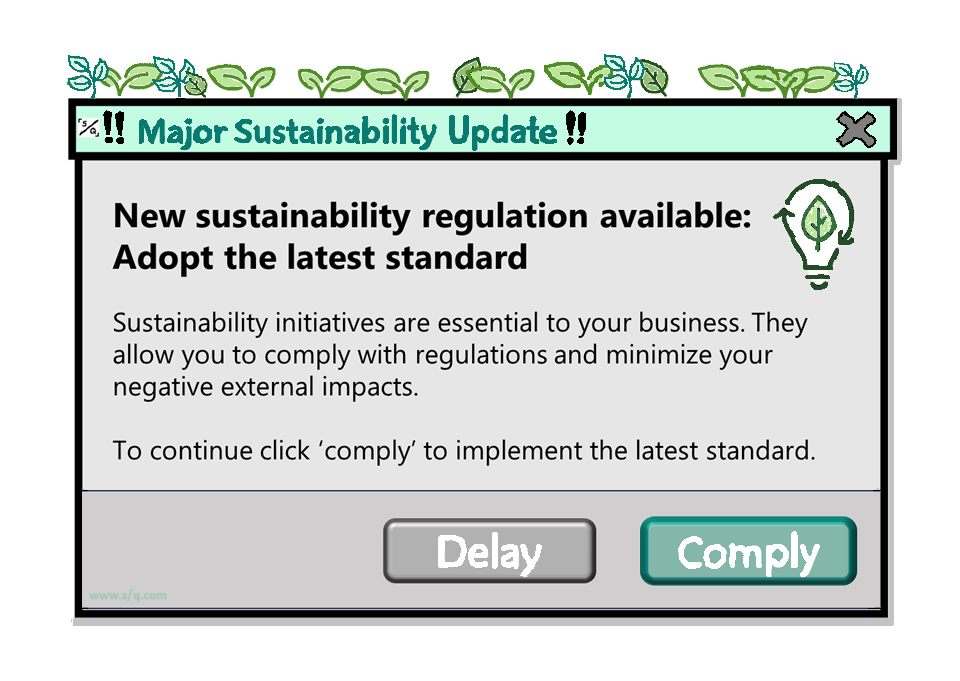
    New regulations impose mandatory compliance obligations, rendering sustainability no longer option.


    1. Competitiveness

    Regulatory advantage: Sustainable companies, products and services have a clear advantage over their peers. These advantages will accelerate over time, because, most of the world’s economies are on the same trajectory – decarbonation in line with the Paris Agreement. Accordingly, regulatory regimes prioritizing sustainable activities will be replicated and enacted the world over – thus advantages driven by regulatory change in one market will replicable.


    Funding: Sustainable companies get preferential access to capital, be it in the form of sustainable investment, green loans, bonds, or grants. Likewise commercial opportunities may be reserved for sustainable such as government procurement.  


    Reputation: Consumers, customers, and talent have all expressed a desire to work for sustainable companies. All else being equal, sustainable products and services win out.


    1. Early-mover advantage


    For sustainability, the first ones in will reap the best options. Preferred suppliers, coveted protected technologies, even acquiring whole companies to monopolize new sustainability advantages.


    Those coming late will have a lot of catch up to do, with less desirable options available to help them get there. In the future access to markets will depend upon sustainable adaptation. This is because as countries impose stricter regulations on domestic companies to prioritize sustainability, they will impose reciprocal conditions on imported products and services. We are already seeing this with Carbon Border Adjustment Mechanisms.

  • Q. How are international laws responding to climate change relevant to supply chain?

    1. Domestic law: Countries are introducing laws to combat climate change in order to meet their commitments in the Paris Agreement.

    Foundational climate agreements (namely, the United Nations Framework Convention on Climate Change (UNFCCC), the Kyoto Protocol and the Paris Agreement) bind countries to certain obligations to address climate change via mitigate and adaptation strategies. Consequently, regulatory changes to decarbonize domestic economies are now the norm, including, obligations to transition to renewable energy, prioritize electric transportation, and mitigation incentives (markets, taxes, and subsidies).

    1. Progressive implementation: The Paris Agreement requires that the states periodically communicate new climate targets.

    In 2025, new targets ending in 2030 and 2035 were announced. Organizations can ascertain which new domestic laws will be forthcoming based upon the contents of these targets (called Nationally Determined Contributions). In order to meet NDCs countries will need to decarbonize their economies by regulating high emission industries and activities.

    Moreover, because the commitments in the Paris Agreement are progressive missed targets may draw particular attention to industries unable to reduce emissions. Even where targets are met, the future targets will be more ambitious in order to meet the 1.5 and 2 degree objective. Accordingly, high emission industries will always have a target on their back.

    1. Increased reporting: Many countries have introduced transparency and reporting obligations on companies, in order to satisfy transparency reporting obligations contained in the Paris Agreement.

    Companies or their suppliers may find that their environmental performance is publicly available, or even scrutinized. Likewise, since the performance of suppliers may likewise become publicly available, data included in Sustainability Report, ESG Ratings, and progress communications risks being contradicted. 

  • Q. How do climate change and the Paris Agreement factor into sustainability?

    Sustainability, risk management,
    1. Unsustainable activities cause and accelerate climate change

    As explained here sustainable activities are inherently not degenerative. Thus, in general activities which contribute to climate change, cannot be considered sustainable.

    Of course, activities will have positive and negative impacts in a range of domains. New sustainability regulations account for this by defining priorities, and unacceptable impacts. For example, the EU Taxonomy requires that sustainable activities make a “substantial contribution” to at least one of the six Taxonomy environmental objectives, without doing “significant harm” to any of the other five objectives. Furthermore, all sustainable activities must uphold standards in relation to human rights, labor standards, corruption, tax and competition, called Minimum Safeguards.   

    1. Urgency of the climate emergency

    Climate positive regulations and activities have become a priority due to the catastrophic impacts of climate change. New venues of international cooperation have emerged to respond to the unprecedented threat, and the Paris Agreement effective since 2016, obliges countries to address climate change via mitigate and adaptation strategies. Consequently, climate laws have proliferated as countries endeavor to decarbonize their economies. Because the predominant focus of these new laws is on climate and environmental measures, engaging in sustainable activities in these realms is no longer optional.

    1. Incentivization of regenerative activities

    The bar is being raised to higher standard – specifically, the gold standard of regenerative activities. Regenerative activities go beyond the baseline of ‘do no harm’ to instead provide for recovery and restoration of natural systems. As regenerative activities are prioritized going forward, the largest incentives packages will be attached to regenerative activities. Companies which can introduce regenerative practices will be prized.

  • Q. Why are there so many sustainability laws now?


    Sustainability laws
    , referring to laws that curb degenerative human activity, are not new. Rather, recent regulations have broadened the scope of conduct subject to scrutiny. These regulations fall into three overlapping categories:


    1. Laws of Direct Application
    These are the oldest sustainability laws. They directly regulate conduct in areas that contribute to sustainability. These laws are passed in specific countries or states and place direct obligations on businesses or individuals to comply.
    Examples: Environmental laws, labor laws, human rights laws, consumer protection laws.


    2. Laws of Indirect Application

    These laws regulate third-party actions or cumulative impacts and often apply extraterritorially (regulating conduct that occurs internationally). These laws place obligations on businesses or individuals operating in one country concerning the conduct of third parties or the impact of their products or services. Often, laws of indirect application impose both direct and indirect obligations.
    Examples: Anti-corruption laws, Extended Producer Responsibility (EPR), modern slavery laws.


    3. Transparency or Reporting Laws
    These laws require reporting on compliance with the first two categories (laws of direct and indirect application) and are, therefore, a combination of the two. They represent the newest form of sustainability laws, in particular laws requiring ESG disclosures. Many new transparency and reporting laws are specifically focused on responding to climate change.
    Examples: Corporate Sustainability Reporting Directive, Sustainable Finance Disclosure Regulation.

  • Q. What is the difference between Sustainability and ESG?

    Sustain vs esg
    1. Sustainability

    Sustainability doesn’t have a single fixed definition. It’s often used as shorthand for “sustainable development,” which the United Nations defines as “meeting the needs of the present without compromising the ability of future generations to meet their own needs.” Put simply, a sustainable activity avoids long-term harm; it is not degenerative. Sustainable development is a core principle behind the UN’s Sustainable Development Goals and has been adopted by both public institutions and private companies. In the private sector, sustainability has emerged at the intersection of corporate social responsibility, globalization, and climate change. Recent efforts have focused on standardizing sustainability reporting, in particular the Global Reporting Initiative (GRI).

    2. ESG

    ESG is a newer concept, originally developed by the United Nations, however instead with a focus on capital markets as a way to measure how investments and companies perform against Environmental (E), Social (S), and Governance (G) criteria. The UN Principles for Responsible Investment (PRI) incorporated ESG criteria as a factor in investment decisions. Subsequently, standards, frameworks, and ratings have been developed to voluntarily track and disclose ESG performance. There is no universal definition of the issues that fall within ESG considerations, rather, specific standards and frameworks will identify which considerations are relevant for each ESG category, with some also assessing based on industry-specific criteria. Standards generally require ESG disclosures based upon either materiality (the impact of sustainability on financial performance) or double materiality (the impact of sustainability on financial performance and the impact of organizational decisions on the environment and wider society). Recent laws have made ESG disclosures mandatory by requiring ESG reporting, a key example being the EU Directive on Corporate Sustainability Reporting (CSRD).

    3. How is sustainability different from ESG?

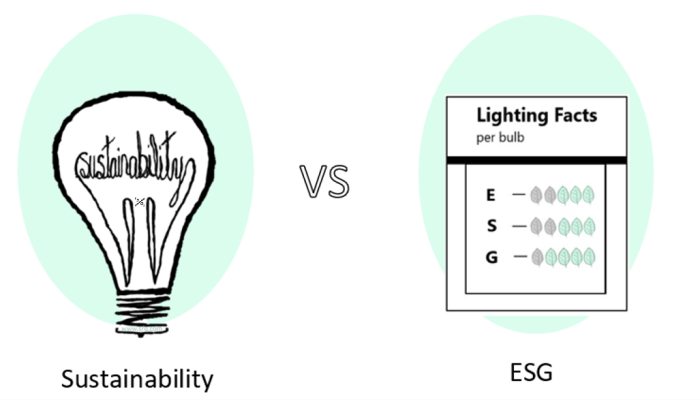
    Big picture – sustainability is a broad concept referring to any activity that is not degenerative, whereas ESG is a measurement system that quantifies certain elements and impacts relevant to sustainability. Think of it like a light bulb, which emits more or less light over a set period, measured in lumens, watts, and lifespan. Similarly, ESG quantifies an organization’s environmental, social, and governance performance to measure and showcase how it performs on these aspects of sustainability. Accordingly, ESG measurements can play a pivotal role in accelerating sustainability accomplishments, provided that they are grounded in sound data. By assessing and disclosing performance in relation to ESG criteria, organizations can credibly identify strengths, benchmark progress, and communicate results to stakeholders. Likewise, lower ESG ratings or lagging indicators can serve as critical signals, highlighting underperforming areas that may otherwise remain unnoticed. Thus, ESG measurements can help integrate sustainability considerations into strategic decision-making, thereby driving positive change.