
- Sustainability professionals and subject matter experts
Sustainability professionals and subject matter experts are essential to conceptualize, develop and drive sustainability initiatives. These are engineers, scientists, developers, supply chain experts, business personnel and others who have the technical skills and experience to revolutionize products, services, and operations.
- Accountants and Lawyers
Both lawyers and accounts excel in highlighting in managing risk and can therefore act as guardrails to keep your sustainability goals on track and realistic.
Accountants can assess the financial impact of sustainability, and measure ESG. Recent ESG disclosure legislation includes assurance requirements, therefore accounts will be indispensable for reviewing, measuring and validating ESG going forward.
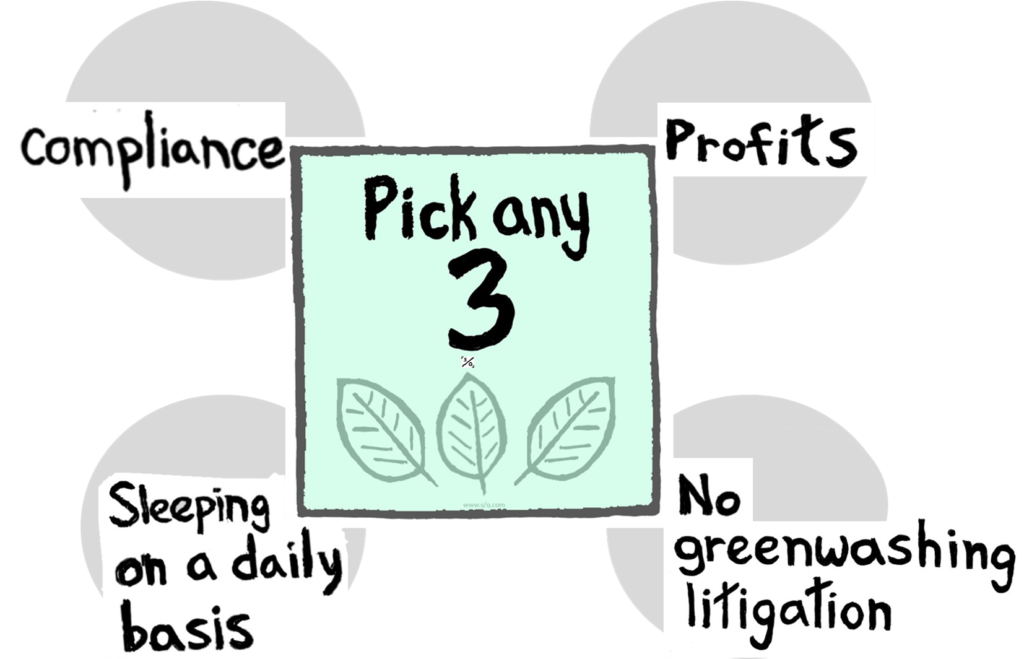
Lawyers are trained in systems thinking, they can adopt a big picture to show how issues may start a chain reaction and may play out down the road. Lawyers also view compliance more wholistically, and therefore can advise on being efficient in risk screening, for example, a company can screen for corruption and bribery in their supply chain at the same time they screen for forced labor violations. Lastly lawyers reduce the risk of greenwashing litigation and non-compliance by ensuring claims are not misleading, and have a basis in realty, this can be accomplished by ensuring claims have supporting evidence, or contractual commitments from suppliers to deliver on the sustainable claim.
- Stakeholders
An effective sustainability program will include supply chain, which can be understood as a network of stakeholders. Cooperative partnerships with suppliers, employees, industry and trade associations, regulators, NGOs, and local communities are all required.
Leadership buy-in is essential for sustainability initiatives. Such attentiveness should not be taken for granted as courts and regulators are now grappling with the question of whether persons in a fiduciary position are legally obligated to factor sustainability risks into their decision making.